[add_art id=”206″]
Why is this so important and what can we do about it?
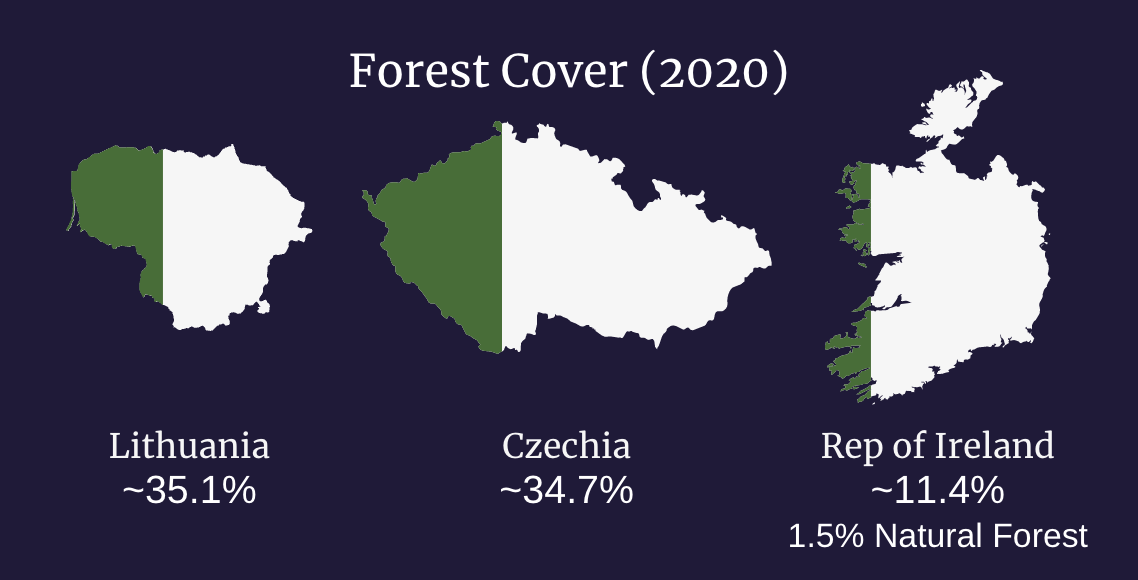
Compared to similar sized countries in wider Europe, it is evident that Ireland must do more to combat biodiversity loss, improve carbon sequestration, and rewild more areas.
A natural forest is one “which has reproduced naturally, consisting of naturally immigrant or indigenous tree species and strains.”
Natural Forest Standard
Sources: Irish Times, Natural Forest Standard, World Bank, Mapfight
Why is it like this?
Eoghan Daltun suggests the problems stem from mismanagement of land, particularly in allowing invasive species such as rhododendron to proliferate and overgrazing by cattle, deer, and sheep.
Farmers are incentivised to make their land “utilisable” for agriculture to qualify for subsidies, which leads to huge gorse fires every year. Laws for the protection of species and habitats in these cases are not fully enforced currently, badly impacting biodiversity.

Difficulties arise where rural communities and a sizeable industry are reliant on this type of agriculture. The government needs to take a measured or balanced approach in bringing about policy and action.
Minister for Environment Eamon Ryan said that “it’s a politics of division” if all interest groups are not addressed and given a voice.
The approach taken in phase 1 of the land use review carried out by the Government of Ireland is written with this consideration, by offering an anthropocentric, market-based framework – an economic system centred on humans.
Sources: Irish Times, Irish Government, Superfolk
So, what can we do?
The Government of Ireland maintains strict anthropocentrism, placing instrumental value on land in relation to human use rather than acknowledging its intrinsic value and rights, independent of humans.
An alternative approach is Ecocentrism.
[For more on Ecocentrism see our previous post on Climate Action Approaches]
For example
- In East Sussex in England a river has been granted legal rights to strengthen its “voice” and provide more grounds for local governments to tackle pollution, protecting the river’s ecology and environment.
- In 2021 Maeve O’Neill, a People Before Profit councillor for Derry City and Strabane, put forward a motion that was carried unanimously recognising the “rights of nature”. The intention is to express these rights in future governmental objectives, approaches, and strategies.
Changing the framing…
Eamon Ryan intends to set the guiding principle of inclusion to drive the review process, ensuring that the consultation gets the “framing of this right” – taking into consideration all interest groups and representation.
How we discuss it, how we present it… How we tell the story, how we listen to each other and share perspectives. How we need to be willing to admit mistakes, and go back and accelerate in the direction we need to go
Eamon Ryan
What do you think?
- Which approach do you think is most effective in approaching land use: strict anthropocentric, weak anthropocentric or ecocentric?
- Do you believe they are taking the right approach?
- What ideas do you have in regards to doing more to improve land use and management?
[ai_shortcode ids=”143, 209, 210, 211, 212, 213″]