What beef means in our diets
The British Dietetic Association has confirmed that well-planned vegan diets (exclusive of meat, eggs, and dairy) can support healthy living in people of all ages.
Meanwhile…
The “Dublin Declaration”, by livestock industry promoters Animal Task Force, states that while it may be possible for “well-resourced” individuals to have an adequate diet while restricting meat, dairy, and eggs, this should not be recommended for the general population, particularly groups of people with elevated needs in developed economies.
In addition, the UN FAO has produced a comprehensive analysis of 500 scientific papers and almost 250 policy documents, concluding that meat, eggs and milk are an “essential source of nutrients” for many globally.
But…
In India, as many as 40% of people are vegetarian, and more are restrictive in their meat eating. Vegetarianism is often adopted for cultural or religious reasons, but when contrasted with previous studies it still begs the question:
Is meat essential in our diets or is our overall understanding of a balanced diet not clear?
Sources: Vegan Society, University of Oxford, Agriland, UN FAO, Statista, Pew Research

Got beef?
As mentioned in our previous post, vested interests wield influence and protect the status-quo. For example, recently the Environmental Protection Agency in the Republic of Ireland deleted a social media post promoting “Meat Free Mondays” after objections from the Irish Farmers’ Association.
Education and promotion, by government or private bodies, can incentivise behaviour both in production and consumption. A famous example is the Got Milk? campaign run by the California Milk Processor Board – often considered a benchmark in marketing.
Government can do more to incentivise producers and consumers alike through investment, taxation and re-alignment of practice. For example, recently the French government decided to pay winemakers to switch crops due to decreased demand and climate change.
Sources: The Journal, Saveur, Politico

Maybe we need something more radical
George Monbiot argues that even moving toward organic and/or regenerative beef (or meat) farming is not a fix given current levels of demand and that it makes sense instead to dedicate land to plant farming:
Only when livestock numbers fall so far that their husbandry scarcely qualifies as food production is animal farming compatible with rich, functional ecosystems. For example, the Knepp Wildland project… is often cited as an example of how meat and wildlife can be reconciled. But while it provides an excellent example of rewilding, it offers a terrible example of food production. If their system were to be rolled out across 10 per cent of the UK’s farmland, and if, as its champions propose, we obtained our meat this way, it would furnish each of the people of the United Kingdom with 420 grammes per year, enough for around three meals. This means a 99.5 per cent cut in our consumption.
George Monbiot, Regenesis

What do the people think?
In 2022, a study produced by the Economic & Social Research Institute in partnership with the Environmental Protection Agency in the Republic of Ireland found that younger people are willing to eat less meat, but see the Government as having the responsibility to bring about change.
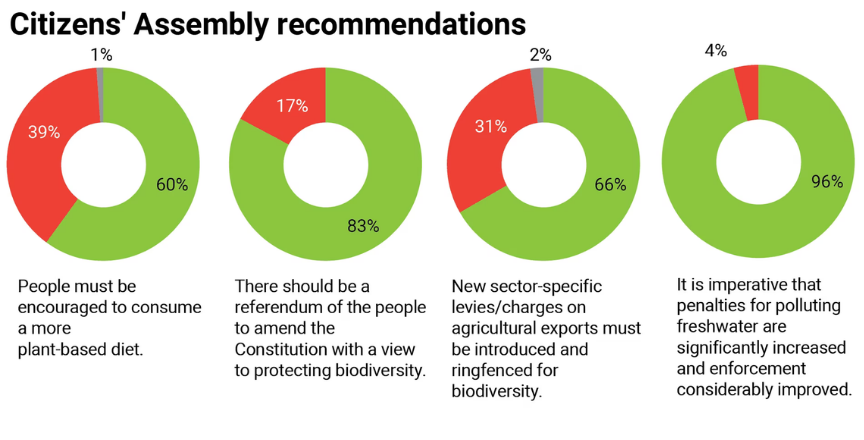
In 2023, the Citizens’ Assembly in the Republic on biodiversity loss issued a report calling for a fundamental review of the current state policy on biodiversity management on agricultural land. The report recommends that the public be encouraged to adopt a more plant-based diet, with 60% of the group voting in favour of the proposal.
Both reports are indicative of the changing cultural trends which may lead to more sustainable diets in future. But as both studies point out, there is a belief government is central to facilitating the transition therefore needs to take a more active role in aiding the public.
What do you think?
How do you think the state can change people’s eating behaviours?
Is it government overreach? Еven in a climate crisis?
Where does individual responsibility stop and collective action start?