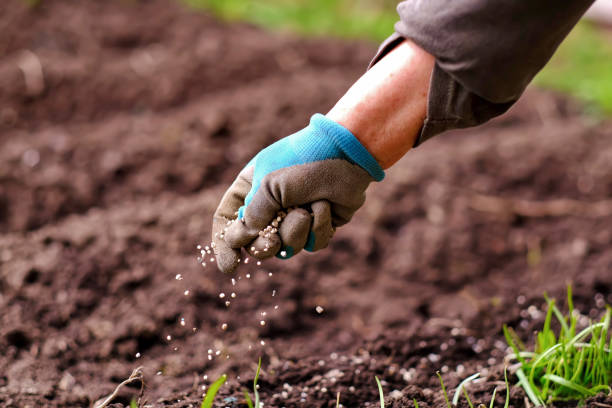
So, what are chemical fertilisers and how are they made?

Chemical fertilisers are used to provide plants and crops with nutrients they may not be able to extract from the air, usually in a concentrated form.
There are three types of fertiliser: nitrogen, phosphate, and potassium (potash).
Nitrogen is typically produced in the Haber-Bosch process – methane is burned, then combined with nitrogen to produce ammonia, which is cooled to a liquid to allow transport.
High levels of nitrogen and ammonia disrupt ecosystems. Excessive nitrogen use increases nitrous oxide emissions from soil organisms. This is a greenhouse gas, 300 times more potent than carbon dioxide.
Phosphate and potash require intensive energy to be extracted from mineral ores, creating by-products such as heavy metals like cadmium and lead, which are significant pollutants.
Sources: Carbon Brief, World Bank

Three of the biggest suppliers of fertilisers are Russia, Belarus, and China. The war in Ukraine means there is no engagement with the UK, EU or USA, though sanctions are still not in place regarding fertilisers. This has led to increased prices, scarcity, and could lead to significant food crises.
This highlights the role of geopolitics in fossil fuel intensive industries, and food production & security.
Solutions & Alternatives

Similar to renewable energy, development of sources of fertiliser locally or nationally instead of importing them provides greater control of price and availability.
It also allows mitigation of the significant emissions that surround extraction, production and use of chemical fertilisers.
Some alternatives considered are:
- Seaweed is an effective substitute as fertiliser, helps improve soil health, in particular microbe growth aiding nutrient sequestering and carbon capture
- Technology to understand soil health, nutrition levels, crop health and progress, etc would facilitate improved fertiliser use
- Human waste works as effectively as other organic fertilisers, and studies suggest it doesn’t transmit disease, or transfer pharmaceuticals to crop material
Sources: Frontiers, The Guardian, Nature, Gov.uk

Some good news
The fertiliser crisis has not been ignored entirely.
The EU Parliament passed a call to action, supported by Irish MEP Colm Markey, to reduce prices and ensure supply. Markey highlighted the need to move away from synthetic fertilisers in general and that the resolution is a short term fix.
The UK government announced a fund of £168 million, providing grants to farmers to “drive innovation, improve productivity, and support animal health & welfare through greener equipment, robotics and automation”. It may be with a devolved government restored in Northern Ireland that a similar fund will be established.

On a neutral note…
The Department for Agriculture, Environment and Rural Affairs (DAERA) in Northern Ireland has an Ammonia Strategy in consultation, closing 3rd March. The strategy outlines guidance for reduction in ammonia use and emissions through improved equipment, technologies, and processes.
Friends of the Earth NI argues that these measures don’t go far enough due to their voluntary nature and estimated only 25% reduction in ammonia emissions.
The estimations provided refer to “emerging technologies” and “verifiable ammonia reduction technology” which suggests reliance on yet to emerge, non-existent solutions.
What do you think?
Can you think of any other alternative fertilisers we could use or are being used?
Would you eat fruit or vegetables fertilised with human waste?
Do you think the Ammonia Strategy in NI goes far enough?
Leave a Reply